
Finding a Family Dentist in Elmira NY: What to Actually Look For
Finding a dentist your whole family will actually like coming to is harder than it should be. Here’s what matters when you’re choosing — and what’s mostly noise.
What "Family Dentist" Should Actually Mean
From a 37-year Elmira practice
Choosing a family dentist in Elmira NY is one of those decisions most people put off until something goes wrong. Then they end up at whichever practice has an opening this week, often regretting it within a year. The right dentist is someone you can rely on for decades — through your kids’ first cleanings, your own routine care, and the eventual procedures that come with age. Choosing the wrong one usually shows up as bouncing from practice to practice, year after year.
This guide is what we tell our friends and neighbors when they ask. We’ve practiced in Elmira for over 37 years, so we know what local families actually want — and what’s mostly marketing noise.
What “Family Dentist” Should Actually Mean
The phrase “family dentist” gets thrown around a lot. In practice, what you should expect is:
- One office that handles every age. Toddlers’ first checkups through teenagers’ orthodontic referrals, working adults’ routine care, and seniors’ more complex needs.
- Predictable continuity. The same hygienist or dentist remembers your family from year to year. They know your kid hates the suction tool. They remember your husband’s gag reflex. They notice when something’s different.
- A range of services so you don’t have to bounce around. Cleanings, fillings, crowns, extractions, cosmetic work, sleep apnea, sometimes implants — all under one roof, or with trusted referrals when something specialized is needed.
- Long-term thinking. Your dentist is planning around the next 20 years of your dental health, not the next 6 months. Decisions about whether to crown a tooth, watch a small cavity, or pursue a more involved repair should fit your life, not the practice’s calendar.
That last point is underrated. A dentist who’s thinking about your long-term health makes very different recommendations than one who’s optimizing for this quarter’s revenue.
The Eight Things That Actually Matter
1. The team’s tenure
This is the single most overlooked predictor of practice quality. If hygienists, assistants, and front-desk staff have been in the same office for 5, 10, or 15+ years, the practice is being run well. Good people don’t stay at bad practices.
Conversely: if every visit you meet someone new, the practice has churn — and churn affects your continuity of care more than almost anything else.
2. How they treat anxious or hesitant patients
Even if you are perfectly comfortable at the dentist, you may have a kid who isn’t. Or a spouse who hasn’t been in a decade. Or a parent who’s had bad experiences. Watch how the practice talks about dental anxiety on their website, in reviews, and on the phone. Generic “we’re a gentle dentist!” language is meaningless. Specific stories from real patients — the ones who took breaks, who used noise-canceling headphones, who came back after years of avoidance — tell you the truth.
3. How long they spend with patients
Some practices schedule cleanings every 30 minutes. Others give an hour. Some dentists do hygiene exams in 90 seconds; others actually look. You can usually tell during your first visit, but reviews give you a hint — patients of rushed practices complain that no one explained anything.
4. Their approach to recommendations
A trustworthy dentist tells you when not to do something. “This filling is small enough to watch for now.” “That crown can wait another year if it’s stable.” “You don’t actually need whitening — your teeth look great.” If every visit ends with a list of new procedures and no “actually, you’re fine,” trust your instincts.
5. Insurance and payment transparency
Good practices are upfront about what’s covered, what isn’t, and what things cost — before you commit. They give written estimates. They explain alternatives at different price points. The phrase “we’ll figure that out later” is a bad sign.
6. The technology question (more nuanced than it sounds)
Modern technology — digital X-rays, intraoral cameras, 3D imaging for implants — does matter. But “we have lasers!” or “we use AI!” doesn’t automatically mean better care. The best practices use modern tools when they actually improve outcomes, and don’t waste your money on procedures that don’t.
7. Referral patterns
A general dentist who knows when to send you out for specialized care — orthodontics, complex oral surgery, certain implant cases — is doing it right. A dentist who insists on doing everything in-house, even cases beyond their training, isn’t always serving your interests.
8. Real-world reviews, read carefully
Skim past the 5-star generic reviews (“great office!”). Read the 3- and 4-star reviews — those tell you what frustrated patients and what they still appreciated. Look for specific stories that match your family’s situation.
What to Ignore When Choosing a Dentist
A few things matter less than you might think:
- Office decor and waiting room TVs. Pleasant, sure. Unrelated to clinical quality.
- The newest, fanciest equipment. Useful when relevant, but a great dentist with mid-range tech beats a mediocre dentist with the latest toys, every time.
- Number of locations. Multi-location practices can be excellent or impersonal — depends on the practice. Don’t assume bigger = better.
- How busy they are. Booked-out three months matters less than how they handle the visits you do get. Some great dentists have openings; some mediocre ones don’t.
- How aggressive they are with check-ups. Twice-yearly cleanings are right for most people. Practices that recommend cleanings every three months for everyone, regardless of need, are sometimes optimizing the wrong thing.
Questions Worth Asking on Your First Call
You can learn a lot from a 5-minute phone call. Try these:
- “How long have your hygienists been with the practice?”
- “Do you do most of your treatment in-house, or do you refer out for specialized care?”
- “How do you handle patients who haven’t been to the dentist in a long time?”
- “What does a first visit look like for a new patient?”
- “Do you give written estimates before treatment?”
- “What’s your approach to patients with dental anxiety?”
The way the person at the front desk handles these questions tells you a lot. Crisp, kind, and informed answers reflect a well-run practice. Vague or impatient answers reflect… the same energy throughout the office.
For Families with Kids
If you’re choosing a family dentist with kids in mind, two extra things to look for:
- Comfort with kids. Some general dentists are excellent with children; others prefer to refer to a pediatric specialist. Either is fine — what matters is they’re honest about which they are.
- Realistic prevention conversations. A practice that talks about sealants when appropriate, watches small spots before treating them, and doesn’t push every preventive add-on is more trustworthy than one that loads every kid’s appointment with extras.
For Adults Considering More Complex Work
If your dental needs are beyond routine — implants, full-mouth rehabilitation, sleep apnea treatment, cosmetic work — find a practice that handles those things regularly, not occasionally. The dentist who places one implant a month is going to give you a different result than one who places implants weekly. Same with cosmetic dentistry, sleep medicine, and other areas of focus.
Don’t be shy about asking: “How often do you do this kind of work?” Real expertise sounds confident and specific. Marketing-speak sounds smooth and vague.
How Chemung Family Dental Approaches This
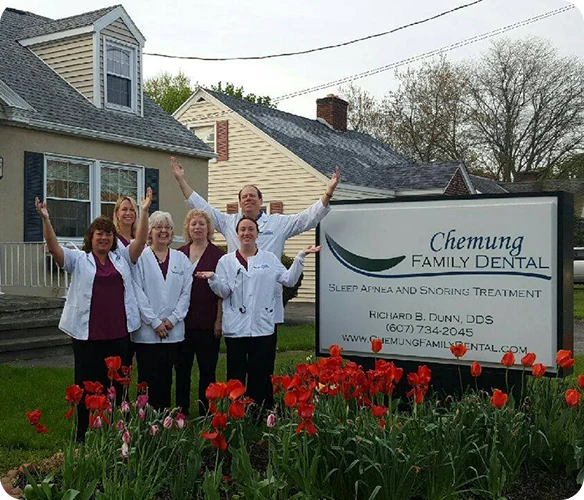
We’ve been a family dentist in Elmira NY for over 37 years. Dr. Richard Dunn founded the practice and still leads it. Our team’s average tenure is over 15 years — the same hygienist who treated your teeth this year will probably still be here for your next decade. We handle most general and family dentistry in-house, including implants, cosmetic dentistry, and dental sleep medicine. For specialized needs we don’t handle ourselves, we refer carefully.
We’re not the right dentist for everyone. We’re not the cheapest, we’re not the trendiest, and we’re not the largest. What we are: the dentist who still knows your name, the practice that works for the families that have trusted us for three decades, and the people who treat dental care as relationship-driven, not transaction-driven. 98% of our patients recommend us — that number doesn’t come from advertising.
The Bottom Line on Choosing a Family Dentist in Elmira NY
The best family dentist in Elmira NY for you isn’t necessarily the one with the flashiest website. It’s the one whose team has been there for years, whose recommendations make sense for the long term, who treats anxious patients the same as confident ones, and who doesn’t try to sell you treatment you don’t need. Take a 5-minute call to test it. Sit through one hygiene appointment. You’ll know.
Frequently Asked Questions
Look for a practice with long-tenured staff (5+ years average), specific patient reviews about how they handle anxiety and complex cases, transparent pricing and written estimates, and a clear approach to long-term oral health rather than transactional care. A short phone call asking specific questions usually reveals more than a website.
A good family dentist handles routine cleanings and exams, fillings, crowns, extractions, basic cosmetic dentistry like whitening, and gum care for patients of all ages. Many also offer implants, dental sleep medicine, and orthodontic referrals. Look for a practice that handles most needs in-house and refers carefully when specialized care is needed.
A trustworthy dentist explains options at different price points, tells you when not to do a procedure, gives written estimates before treatment, refers out when something is beyond their expertise, and has a team that has stayed with the practice for years. They prioritize your long-term health over short-term revenue.
Most adults and children should have a professional cleaning and exam every six months. Patients with active gum disease, certain medical conditions, or higher decay risk may need cleanings every 3–4 months. A trustworthy dentist will tailor frequency to actual need rather than recommend the same schedule for everyone.
Yes. Most general family dentists are trained to treat patients from toddlers to seniors. Some refer young children to pediatric specialists, which is fine — what matters is honesty about which cases they handle confidently versus refer out. The benefit of one office for the whole family is continuity of care and shared family history in one chart.
Ready to experience care that feels different?
Join the families who have trusted us for over 37 years.